Editor’s Note:
This article is part of a Digital Summit Collective series where we’re turning standout live sessions from recent Digital Summit events into actionable, on-demand insights for our community. Each piece is adapted from a real stage presentation—capturing the ideas, examples, and strategic thinking that resonated most with attendees.
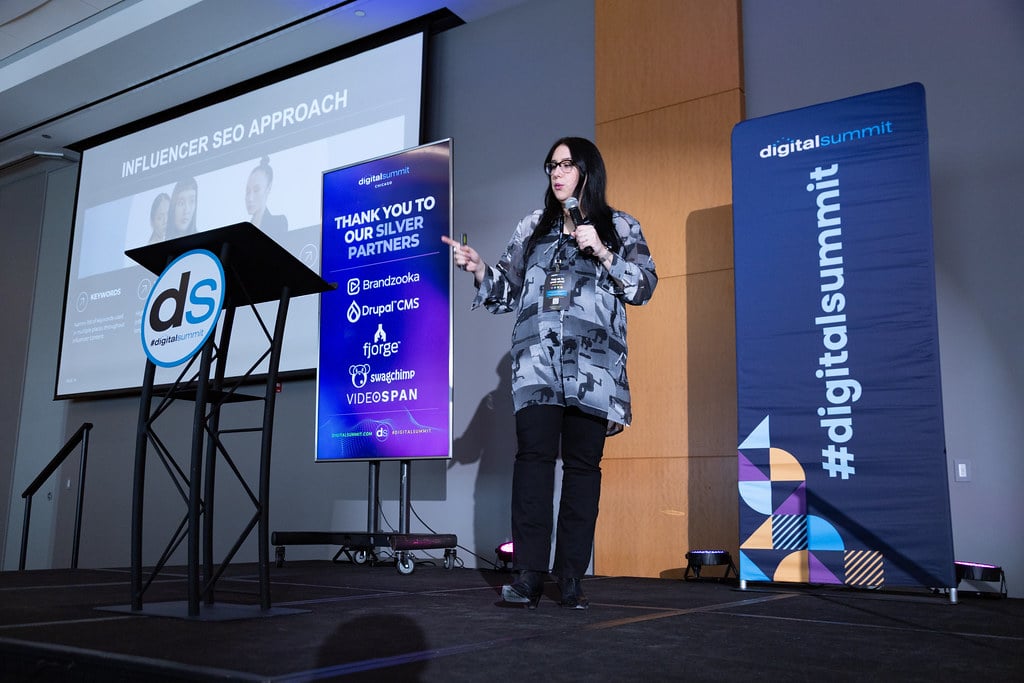
Angie Bolotin didn’t start with tactics. She started with a shift in behavior.
More and more consumers aren’t beginning their searches on Google, rather they’re starting on TikTok.
In fact, 24% of Americans now prefer social platforms for search, and for Gen Z, it’s over 60%.
That change is bigger than it sounds. It doesn’t just affect where people search. It changes how they discover brands in the first place.
Search Didn’t Disappear. It Moved.
Bolotin defines social SEO as the way content gets discovered within social platforms, not just traditional search engines.
It’s important to note that this isn’t replacing traditional SEO. It’s building on it.
Traditional SEO focuses on websites, keywords, and technical performance. Social SEO is driven by content, signals, and engagement. The mechanics are different, but the goal is the same: showing up when someone is looking, even if they don’t know your brand yet.
Discovery Is No Longer Linear
The bigger shift is how the consumer journey actually plays out.
It used to be straightforward. You searched for something, clicked a result, and made a decision.
Now it’s much more fluid.
Someone starts with an unbranded need, searches on TikTok, and gets pulled into a stream of content. One video leads to another. One creator leads to the next. They engage, scroll, and keep going.
At some point in that loop, a brand stands out.
Bolotin shared her own example. She searched for oversized t-shirts and ended up buying from Abercrombie. Then she went back and bought more.
It wasn’t one post that convinced her. It was repeated exposure in a format that felt more personal and more real.
Why Influencers Play a Bigger Role
Brands can absolutely build for social SEO on their own. But influencers help accelerate the process.
They bring an existing audience, a level of trust, and a natural understanding of what performs on each platform. When that is paired with the right keyword strategy, the result is not just reach, but staying power.
This is where the thinking has shifted.
Influencer marketing used to focus on what would perform in the moment. Now it’s also about what will continue to show up in search over time.
Content that is built this way does not disappear after a few days. It continues to surface.
It’s Not Just About Hashtags
One of the biggest misconceptions Bolotin called out is that social SEO is still about captions and hashtags.
That might have worked in the past, but platforms have evolved.
Now they are looking at the entire piece of content. Keywords need to show up in multiple places, including what is said on screen, what appears as text, and how the video is structured.
When all of those elements align, the platform has a much clearer understanding of what the content is about and who it should be shown to.
That alignment is what drives discoverability today.
The Balance Between Search and Performance
Keywords still matter, but they need to be used with intention.
Instead of trying to include as many as possible, the focus should be on one or two core ideas that match what a user is actually searching for.
At the same time, the content still needs to perform.
If it doesn’t hold attention or generate engagement, it won’t surface. No amount of optimization can fix that.
The goal is to create content that answers a question and keeps people watching.
Engagement Is What Extends Reach
This is where social SEO starts to diverge from traditional thinking.
Views and reach are still important, but they are not what determine whether content continues to show up.
Comments and shares carry more weight.
They signal that people are interacting with the content, and that interaction increases the likelihood that it will be surfaced again.
That is why Bolotin emphasized that content with strong engagement can be more valuable than content that simply gets a high number of views.
Engagement gives content a longer life.
How Distribution Supports Discovery
Another area that is evolving is how links are used within influencer content.
“Link in bio” is still part of the mix, but it is no longer enough on its own.
Brands are starting to think more carefully about where links point and how they are introduced. The goal is to create a seamless experience that matches what the user is seeing in the content.
One tactic that is gaining traction is asking users to comment for a link, which is then delivered through a direct message.
This approach increases engagement while also driving traffic, which strengthens both performance and discoverability.
This Requires Ongoing Optimization
Social SEO is not something you set once and leave alone.
It requires constant adjustment.
Teams need to look at what content is performing, which keywords are gaining traction, and how engagement is evolving over time. Those insights should then inform the next round of content.
It also requires coordination.
SEO teams typically define the broader keyword strategy, while social teams translate that into content that feels natural on each platform.
The best results come when both are working together.
What to Do Right Now
-
Treat social as a search channel: Discovery is happening within platforms, not just through traditional search engines.
-
Incorporate keywords throughout the content: Make sure they are reflected in captions, spoken language, and on-screen text.
-
Focus on engagement, not just reach: Comments and shares are stronger indicators of long-term performance.
-
Use influencers to scale discoverability: They can help content surface faster and remain visible longer.
-
Continuously refine your approach: Social SEO evolves quickly. Your strategy should too.
The Bottom Line
Search behavior hasn’t gone away.
It has simply shifted into the feed.
And in that environment, discovery is less about ranking at the top of a page and more about showing up consistently, in the moments when people are already looking.
Watch the Full Session
This article was adapted from the live session The Role of Influencers in Shaping Social SEO & Searchability presented by Angie Bolotin at Digital Summit Chicago 2025.
Watch the full video:
https://resource.digitalsummit.com/resources/material/role-of-influencers-chi25/