Lifestyle
October 2026
The Other Title

Editor’s Note
This article is part of a Digital Summit Collective series where we’re turning standout live sessions from recent Digital Summit events into actionable, on-demand insights for our community. Each piece is adapted from a real stage presentation—capturing the ideas, examples, and strategic thinking that resonated most with attendees.
Understanding what buyers need to make a decision is the key to creating better performing websites, better aligned content, and a better case for being recommended by AI.
Imagine: a potential customer asks an AI tool to help find a company in your industry. They describe their problem, explain their constraints, and ask the AI for some options.
Does your brand make the shortlist? And does the answer accurately explain why you belong there?
For Andy Crestodina, co-founder of Orbit Media Studios, those questions deserve more attention than whether a brand simply appears in an AI response.
During his session at Digital Summit Minneapolis, Crestodina showed how marketers can better align their marketing with buyers, and therefore with AI systems.
His central argument connects search engine optimization with conversion optimization.
The details that help a customer choose your company are the details that help an AI tool understand when to recommend it.
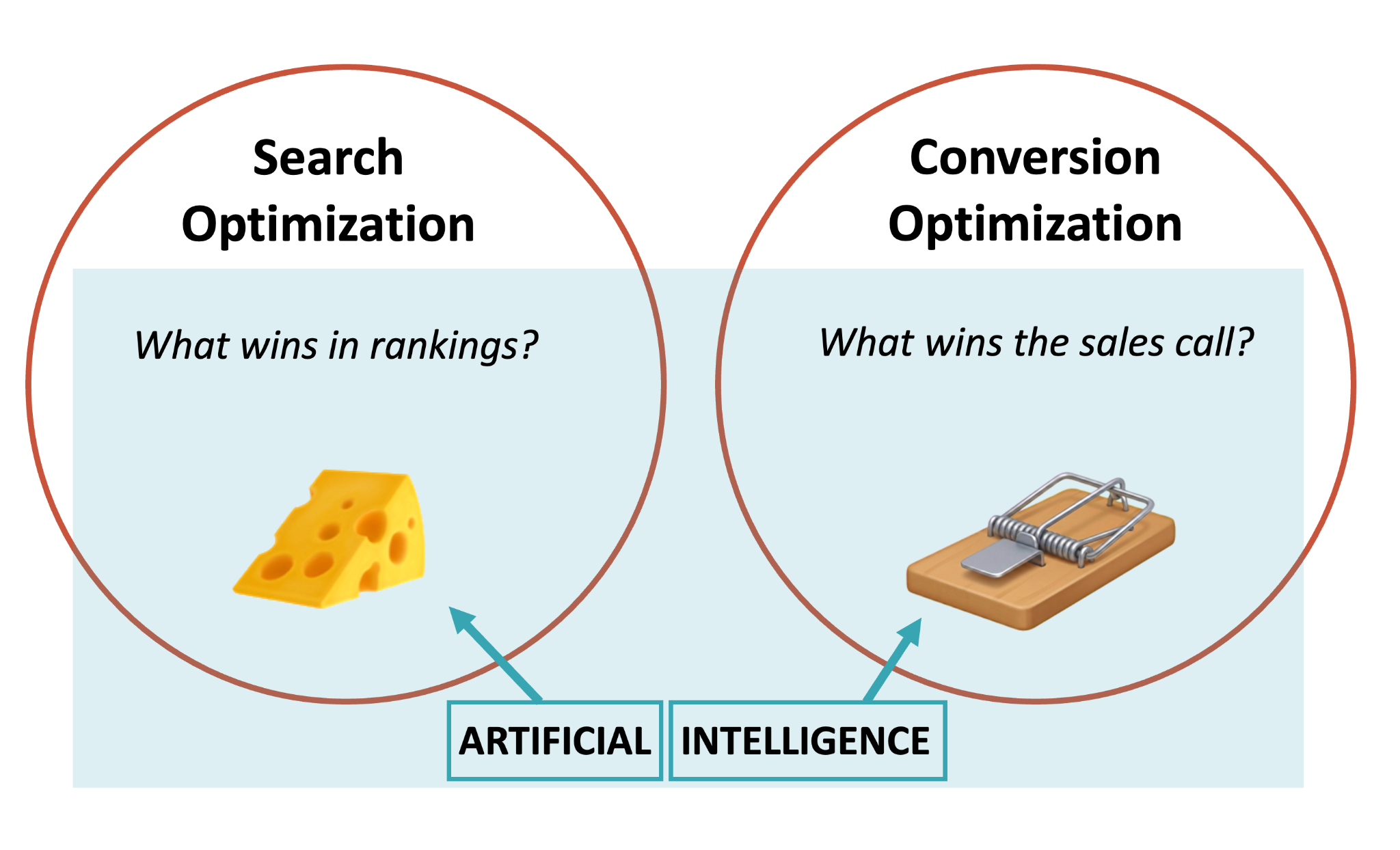
Yes, marketers still need to do good SEO (align pages with phrases, indicate relevance, confirm the site is easy for machines to access) but that’s insufficient. To win at AI search, we need to understand the buyer and what wins the sales call.
In other words, AI search optimization is the intersection of SEO and conversion optimization.
That gives all of us marketers a practical place to begin. Look closely at what your website tells a prospective buyer, what it leaves unanswered, and if you’ve supported your claims with evidence.
Understand the Decision Behind the Search
Someone searching for a service might enter a few words into a search engine. The average search query is maybe 4-5 words long. What happens next? The search engine provides options.
But in an AI conversation, they can explain their role, budget, location, requirements, and desired outcome. The average prompt is quite long. Then ask follow-up questions in more prompts as they narrow their choices. And what happens next is very different: The AI provides recommendations.
Crestodina illustrated this with a buyer looking for concrete formwork suppliers. A broad search identifies a category. A more detailed request specifies high-rise construction, engineering support, load calculations, drawings, and on-site assistance.
Each detail gives the recommendation more context. It also raises a question for the supplier: does its website clearly describe those capabilities? Those details? The proof points?
Crestodina encouraged marketers to think through the information buyers provide when asking for help. A page should explain who the company serves, what it offers, which problems it solves, and what makes it a good fit for a particular situation.
Traditional search fundamentals still matter. His approach extends that work to include the questions customers ask while deciding whether to buy.
Find the Gaps Between Your Capabilities and Your Content
In one example, Crestodina described comparing a transformer company with its competitors using AI. Because AI is looking at the competitive set. The response associated the company with certain needs but favored competitors for others.
The company’s reaction was immediate: it already offered some of the capabilities the answer appeared to overlook.
The next step was to look for those capabilities on its website. Were they explained clearly enough for someone researching the company to find them?
That exercise offers a useful way to identify possible content gaps. Marketers can explore realistic buying scenarios, examine how their brand is described, and compare those descriptions with what their pages actually say.
AI responses can contain errors. No single answer should be taken as truth. It’s foolish to simply trust an AI. But it's a useful tool for spotting gaps. AI can easily audit your content and give you a clear understanding of where your content fails to communicate something a buyer needs to know.
Bring Your Best Evidence Into View
Strong proof often sits several clicks away from the page where a customer first encounters a business.
Crestodina described websites that link to case studies using only a client’s name. The most compelling result might be buried on page four of a downloadable PDF.
His recommendation is straightforward: bring that result forward. A case study preview can include a meaningful outcome or customer quote, giving visitors useful evidence before they open the full story.
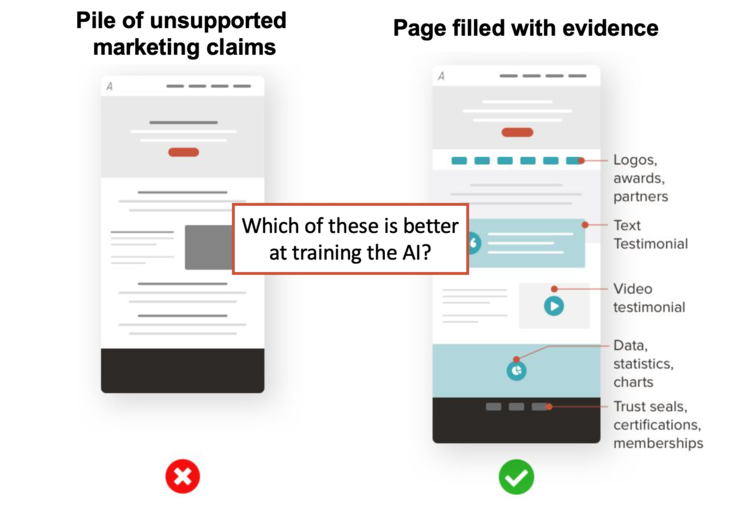
The same principle applies to awards, certifications, and customer logos. Include relevant credentials in readable text alongside the visuals so their meaning is explicit.
Homepages and service pages deserve particular attention. We know from research that AI visits homepages 15x more the other types of pages. The homepage and the services pages should give visitors a clear picture of the company’s expertise and reasons to trust it, with simple answers to real sales questions and supporting evidence for every marketing claim.
Let Customers Supply the Questions
Adding an FAQ section is easy. Knowing which questions belong in it takes more care.
Crestodina challenged the practice of borrowing questions from competitors or relying entirely on keyword tools. Those sources can suggest topics, but your own sales conversations reveal what people actually ask before hiring you.
He demonstrated how sales call transcripts can be analyzed with AI to identify recurring questions, concerns, and decision criteria. Budget, scope, process, and responsibilities become easier to prioritize when marketers can see how often customers raise them.
Those findings should shape the page itself, beyond a simple little question-and-answer box at the bottom. If prospects repeatedly ask how a project works, explain the process. If they need evidence of a particular capability, make that evidence easy to find.
The goal is to close the gap between what your website says and what your customer needs to hear. The goal is to train AI to be a sales rep for your brand.
Be Specific About What You Offer
Vague language makes that gap wider. And taglines don’t train the AI.
Headings such as “Our Services” or “Solutions” offer little information about a company’s work. This was true in the traditional SEO era and it’s more true today.
Crestodina demonstrated a specificity audit covering five elements: the main headline, opening visual area, subheadings, navigation labels, and calls to action. Using a full-page screenshot, he asked AI to identify vague language and suggest clearer alternatives.
A service heading can name the specialty. A description can identify the audience and outcome. A call to action can explain what someone will receive and how much time it requires.
Any suggested revision still needs human review. The value of the exercise is in noticing where familiar language has stopped communicating anything useful.
What To Do Right Now
The Bottom Line: Giving Buyers Reasons to Choose You Also Gives AI Reasons to Recommend You
Crestodina’s approach puts customer understanding at the center of AI search optimization. Marketers need to know what buyers care about, explain how their company meets those needs, and support the explanation with evidence.
These improvements remain valuable wherever a visitor comes from. A clearer website helps people evaluate a business, ask better questions, and decide whether to take the next step.
He also closed with a reminder to keep investing in relationships through events, referrals, email, and community. Search is one way people discover a brand. The broader work of earning trust continues across every interaction.
Watch the Full Session
This article was adapted from Andy's Mastermind Hub presentation How to Get AI to Recommend Your Brand, at Digital Summit Minneapolis. If you are interested in learning more about our Mastermind Hub Track, please visit www.digitalsummit.com for more information.