About this article:
The Spark is a personal essay about the first commercial, campaign, song, or cultural moment that made something click and sparked a career in marketing, and the old-school work that still shapes how they think today.
When I think about my career — why I ended up here, why storytelling has always been the throughline — it actually goes all the way back to childhood.
I was that kid putting on plays in the living room, forcing my parents and family to sit and watch. I didn’t have the language for it then, but I loved the idea of creating something that held people’s attention. That instinct started to take shape in middle school in a slightly more…niche way: Microsoft PowerPoint. I was obsessed. I’d come up with random topics, build out slides, add animations, storyboard the whole thing. It wasn’t homework, it was just fun. Looking back, it was probably my first version of creative direction.
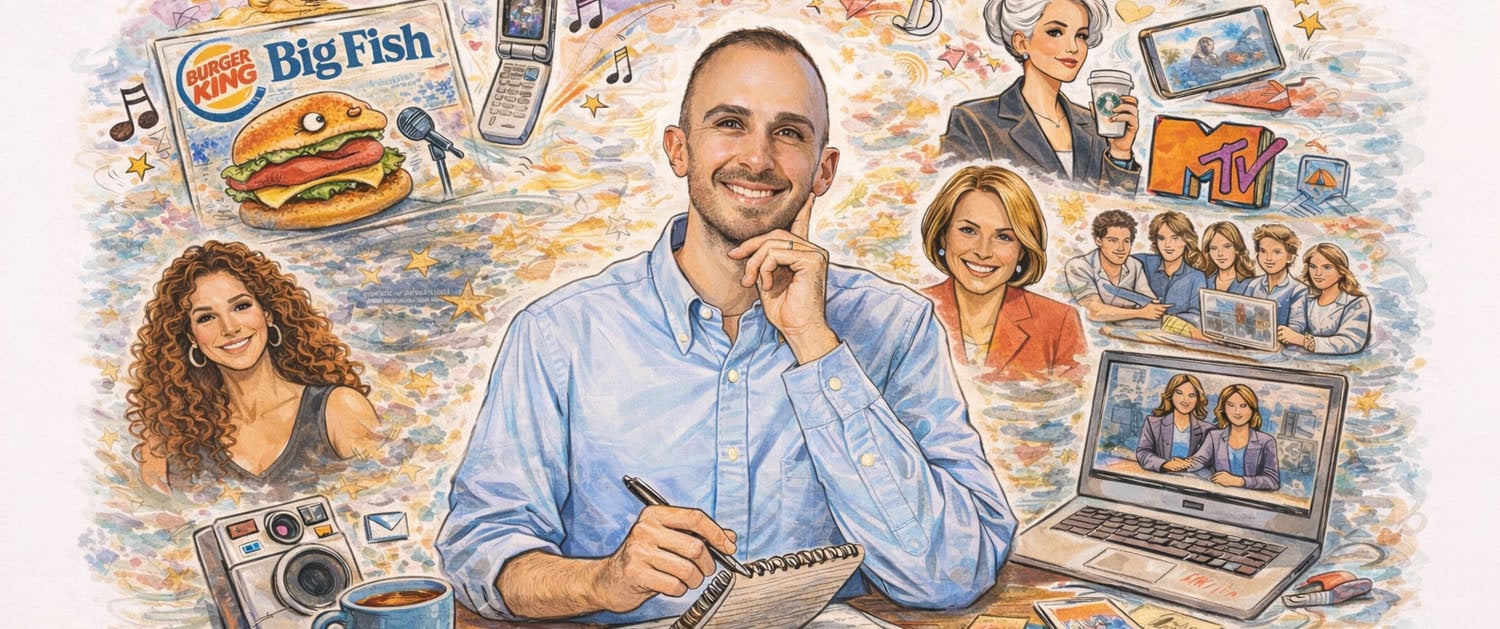
By high school, that interest sharpened into something more specific: I became fascinated not just with stories, but with storytellers themselves — especially journalists. I was watching The Paper on MTV, following a high school newspaper staff like it was a reality show. I was watching The Hills and seeing Lauren Conrad move to LA to work at Teen Vogue. The Devil Wears Prada made the world of magazines feel high-stakes and glamorous. Then there were films like The Post, Bombshell, She Said — all stories about people whose job was to tell stories that mattered.
Even now, if you look at my bookshelf, it’s filled with books by journalists — Elaine Welteroth, Katie Couric, Trey Yingst, Jen Maxfield, Katie Tur. That fascination never really left.
I became editor of my high school newspaper. I wrote and edited for college publications. I contributed to a local paper in Rockland County. I wrote for Elite Daily when it was still a startup. And today, I’ve been published in Adweek, PRWeek, Business Insider, and The Jerusalem Post. Storytelling has always been the constant.
But if I really trace it back to the moment — the first time a piece of marketing made me feel something I couldn’t quite explain — it wasn’t a newsroom or a magazine. It was a McDonald's commercial.
It was for the Big Fish sandwich. Early 2000s. I was in middle school, sitting on my bed, on the phone with a friend. The commercial came on and we both just lost it — hysterically laughing. And here’s the thing: I still remember the jingle. I still remember the exact moment. Where I was sitting. How it felt.
That’s kind of wild, considering I’ve seen thousands — probably millions — of ads since then.
But that one stuck.
At the time, I didn’t think, this is marketing brilliance. I just knew it made me feel something. It made me laugh. And it attached itself to real memories — hanging out in the McDonald's parking lot in high school waiting to see who's house we were going to, those small moments that felt like a treat.
Looking back now, that was the spark. The realization — even if I couldn’t articulate it yet — that brands could create emotion. That creative work could live beyond the moment it aired.
And that idea still shows up in my work today.
Last year, at ARCHER — a dating app for gay and queer men, where I lead brand — we launched a campaign with David Archuleta to promote a product feature called Trophies. The idea behind Trophies is simple: bring what’s usually invisible on dating apps to the surface. Help people show who they are and what they’re into, instantly.
But instead of explaining that in a straightforward way, we built a campaign that made people feel something. We leaned into nostalgia — because Gen Z loves it — and created a spoof of The Devil Wears Prada. David became our “Chief Trophy Officer,” channeling Miranda Priestly, strutting through a fictional ARCHER office surrounded by terrified interns.
It was playful, a little ridiculous, and very intentional. Because the goal wasn’t just to inform. It was to evoke.
The Old-School Lessons I Still Use
If there’s one principle I come back to again and again, it’s this: the best creative makes people feel something.
People don’t want to be sold to. They want to feel something: laughter, nostalgia, connection, even a little discomfort. That’s what sticks.
And I think that’s something the industry sometimes forgets.
Take something as simple as a car. If I were marketing a car, I wouldn’t focus on how it gets you from point A to point B. That’s not what people remember.
What I remember from my own life isn’t the car itself — it’s what happened inside it.
I remember being at soccer practice and looking over to see my dad watching me from the car. He never missed one. I remember sitting in the car with my mom before school, waiting for the bus, while she played Celine Dion, Gloria Estefan, Whitney Houston — the divas. I remember driving my dad’s Honda Element in high school, packing my friends in, folding the seats up.
But those are the memories.
The car was just the container.
That’s the lesson: great marketing isn’t about the product. It’s about the role the product plays in someone’s life. The memories it holds. The emotions it unlocks.
If there’s anything “old school” I think we need to hold onto, it’s that. Before performance metrics, before optimization, before everything became so transactional — there was just the work. And the work made you feel something.
That’s still the bar.
And honestly, it always should be.