
Community
The Reinvention
October 2026


Editor’s Note
This article is part of a Digital Summit Collective series where we’re turning standout live sessions from recent Digital Summit events into actionable, on-demand insights for our community. Each piece is adapted from a real stage presentation—capturing the ideas, examples, and strategic thinking that resonated most with attendees.
When it comes to customer data, we are asking the wrong question. We keep asking for more, usually in the shape of another dashboard. We rarely ask whether we have the discernment to make good decisions with the customer intelligence we already have. Somewhere right now, a team is building a dashboard to explain why their other dashboard missed the churn.
At Digital Summit Atlanta, I shared something I see all the time. A dashboard that shows a healthy customer relationship up until the point that the customer leaves.
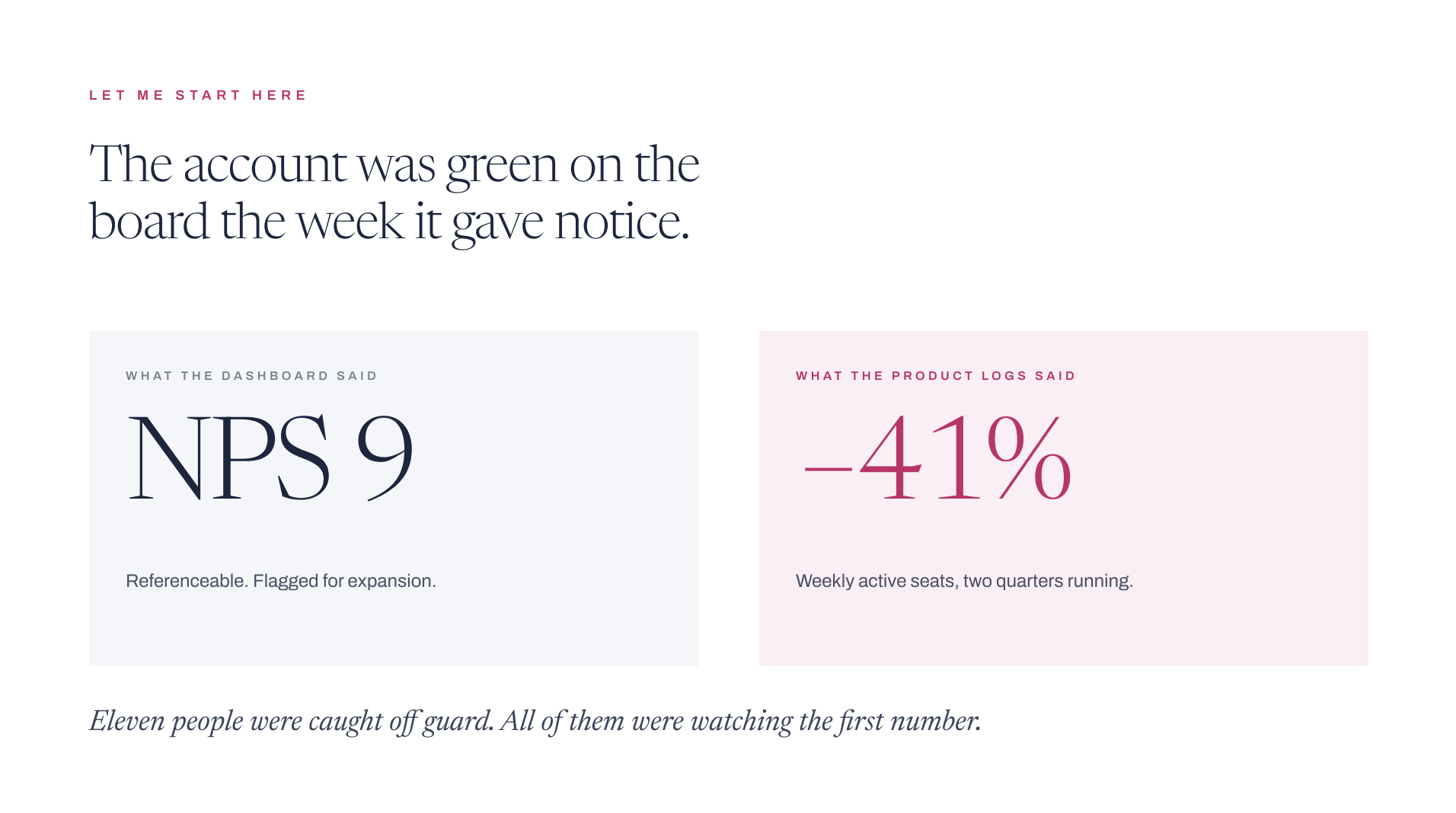 In one composite from client work, the health dashboard showed a 9 on the NPS survey. Meanwhile, the product logs showed weekly active seats down 41% over two quarters. Eleven people were caught off guard, and every one of them had been watching the first number. They had plenty of data. Nobody had checked one signal against the other.
We’ve made NPS this magical, all-knowing metric that tells us whether we’re really doing a good job. It’s become the singular litmus test for our customer experience, and it was never going to be able to do all of that.
In B2B, the person who answers is often an admin or someone who uses the product every day, and sometimes it’s someone who has already moved on. The person who signs the renewal may never see the survey. Recommending you and renewing don’t always go hand in hand. Plenty of customers give a 6 every quarter and keep renewing because leaving would be harder than staying. That customer is stuck, not loyal.
There isn’t one number that tells you whether a customer trusts you. You see it in how they behave: whether usage grows or shrinks, what they keep opening tickets about, how they handle the renewal. You have to look at those together. When we squeeze the relationship into a single score, we stop seeing the people in it. Then we act hurt and surprised when they don’t trust us or feel loyal.
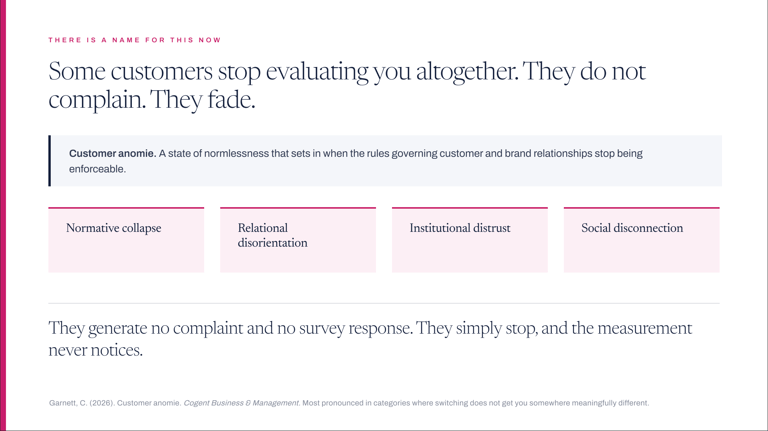
And then there are the customers who simply stop evaluating you at all. They don’t complain, but instead become estranged over time. Émile Durkheim used the word anomie to describe what happens when a society’s shared rules stop holding, and customers go through their own version of that. In my research, I call it customer anomie: a kind of normlessness that sets in when the rules that are supposed to govern the relationship between customers and brands stop being enforceable. These customers don’t answer surveys because they don’t trust that you’ll make anything better with the feedback in them. That lack of response never lowers your score. It just shrinks the sample, and the people you most need to hear from are the ones you never hear from at all.
 Check the context before you act
So what do you do? You need to seek out the bigger picture. You need qualitative and quantitative data. AND you need to build rapport so you can earn the contextual understanding that fills in your customer intelligence gaps.
Behavioral signals tell you what happened. Relational context tells you whether you’re reading it right. Most teams go straight from signal to action and skip the middle step.
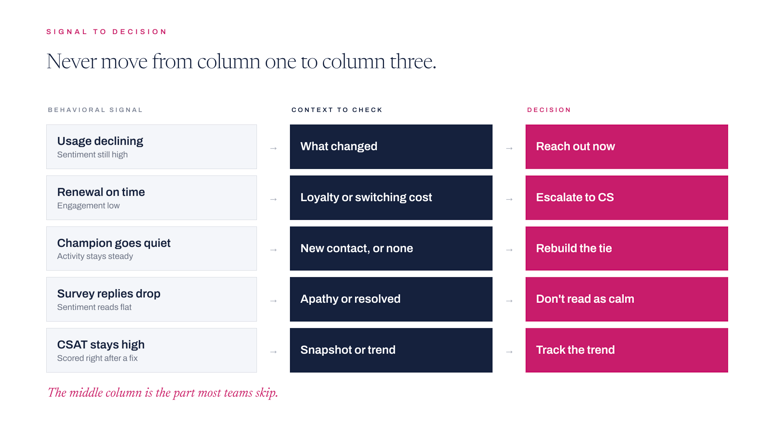 That middle step depends on something I call relational context legitimacy: whether you’ve earned the standing to interpret a customer’s behavior the way you just did. Your dashboard shows what a customer did. It can’t give you permission to act on what you think it means.
Picture the same email sent to a customer after their usage drops: “I noticed your team hasn’t been in the reporting view lately. Did something change on your end?” If it comes from a CSM they’ve worked with for a year, it feels like someone paying attention. If it comes from an address they’ve never seen, it feels like being watched. The words are identical, and so is the data behind them.
The relationship that came before the data makes the difference. Customers who know you, who have told you things directly and seen you use that information on their behalf, read your next move as care. When the only thing connecting you is a tracking pixel, the same move reads as surveillance.
The fifth question is the one that will threaten ego-driven teams. If nobody can say what would change their mind about an account, the team has stopped reading the data and started defending it. They start looking for data that backs up their bias.
“But Christina, I have 3,000 accounts and six CSMs.” I’m not asking you to speak to every single customer. Let behavioral signals run automatically across every account. Spend people’s time on relational context only where those signals raise a flag, which in practice is a few dozen accounts a quarter.
Stop assuming that your dashboard has all the answers and take time to build the customer-brand relationships that give you earned context.
Open your health dashboard and pick the three greenest accounts. For each one, ask: “Who told us this, when, and does their behavior agree?” Usually one of the three doesn’t survive the question. That’s the account to work this week.
The next time someone on your team asks for more customer data, start with what you already have.
This article was adapted from Overcome the Customer Intelligence Trap: When Data Creates False Confidence, presented by Christina Garnett at Digital Summit Atlanta, October 2026.